
The thesis is right there in the title.
 Shop the Store on Amazon ›Follow
New Money: How Payment Became Social Media is a book published in 2020, proposing a new generation of social media based on payment transactions. This idea is a product of its time; throughout the 2010s, fintechs challenged traditional banks in consumer awareness and popularity while social networks matured into habit. In parallel, crypto excitement transmuted attention into currency, pumping up altcoins and shitcoins to crypto enthusiasts[1]. Juxtaposing finance and social media was the next logical step.
Of course, I read this book five years later, and its predictions have failed to materialize. What did it get wrong? Social media evolved from the intimate to the performative, and the transparency of payments are fundamentally incompatible with how we now use social media.
Before we get into that, let's go over the book itself. I'll give the author credit for covering some of the nitty-gritty details of payments. She takes the time to go over the history of credit cards and explains the infrastructure of payments in non-technical language. One chapter describes the business model of card issuers and acquirers, and the role of the Federal Reserve and its maintenance of the Automated Clearing House (ACH) transactions. Another chapter details how fintechs like PayPal rely on account balance floats to generate revenue.
But the positives are outweighed by the poor writing. Basic typos and grammatical errors are scattered throughout the book, eluding both the editor and spellcheck. Sections are stuffed with strings of quotes—other books, academic researchers, random Reddit threads—that render her sentences incomprehensible[2]. Midway through, the author piles on academic jargon, with verbiage like "transactional community" elevated as insight when it's simply…well, just people paying each other. Altogether, these literary faux pas made for tedious reading.
But, I slogged through to look for supporting arguments around the central thesis: that technology is driving convergence between social media and payments.
Even during the time this was written, instances of combining social interactions with transactions were scarce. Payment services like Cashapp, Zelle, and Stripe either left off friend connections entirely, or showed a public feed but maintained tight privacy controls. Conversely, social networks like Instagram and TikTok did incorporate payments, but they focused on integrated checkouts—interactions between consumers and merchants—to bolster their core advertising businesses. Despite all the hype and thinkpieces, Venmo was, and remains, the primary app that scaled the idea of social × payments.
Which gets us back to the question of why this never took off. In the 2010s, we saw signs that online identities were evolving from the decade prior. Twitter was founded on the concept of updating your status for friends, and Facebook encouraged its users to fill out real profiles with real photos. Our online personas were digital extensions of our offline lives.
We collectively recognized that broadcasting personal information to the world bore real costs. The internet's raw speed of communication, reach, and permanence created new social dynamics. Facebook became a site to stalk ex-boyfriends and ex-girlfriends; Twitter's feed lit up with site-wide flame wars and pile-ons. Snapchat was founded in this environment, on the understanding that online transience was desirable. Eventually, users adapted; earnest thoughts and actions gave way to performative bragging and selective messaging.
With users keeping mindful tabs on what they are exposing, transaction data is indeed useful— too useful. At both Square and Affirm, our Data Science and Machine Learning teams used this data internally, for everything from underwriting loans to detecting fraud. More publicly, Target supposedly identified a teenager's secret pregnancy from signals in her shopping patterns. We amuse ourselves with Venmo's emoji-laden reactions, as we literally follow the money and conduct the same detective work to make embarrassing inferences.
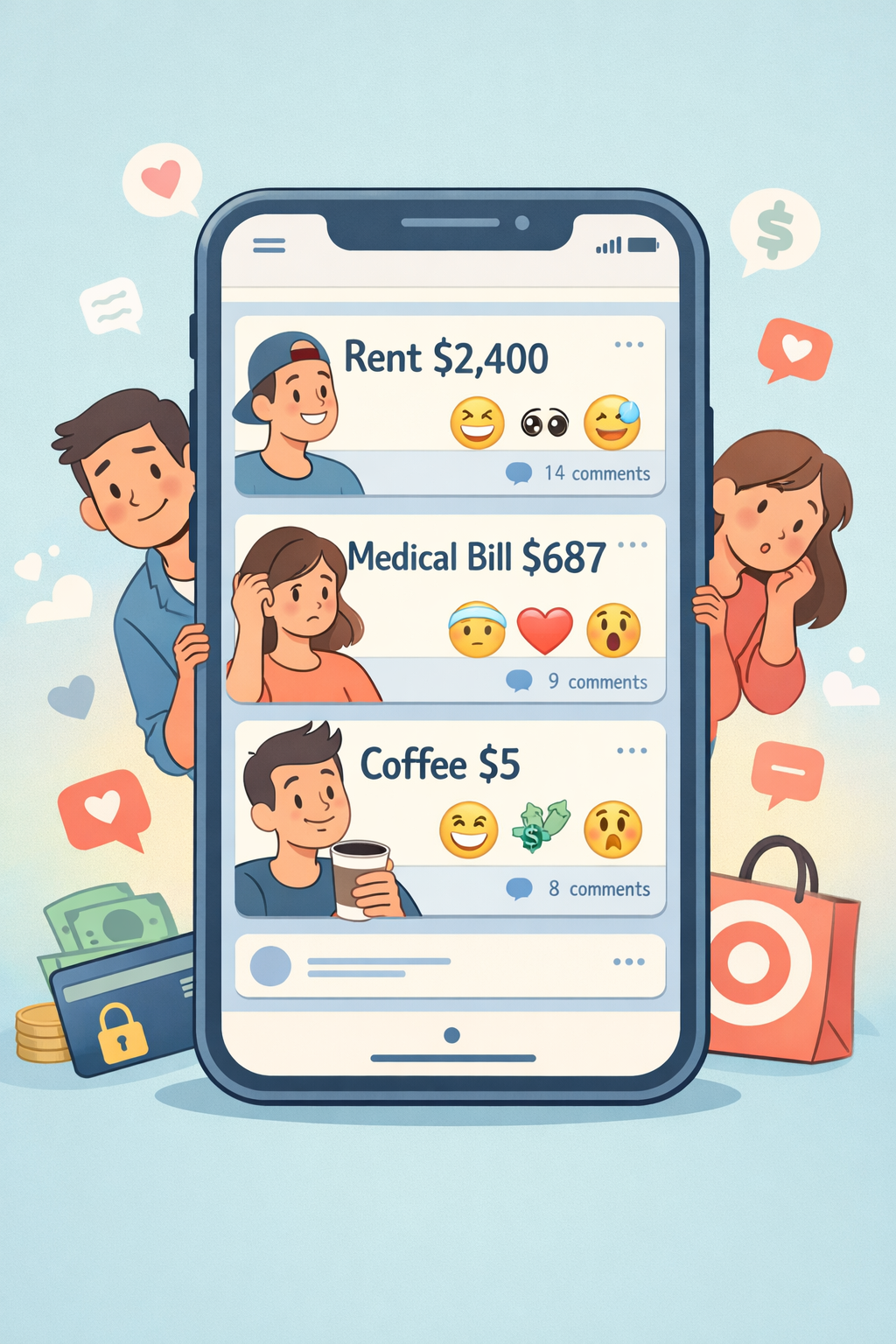
Transaction ledgers don't differentiate between casual and serious, and social media is light on nuance and empathy. Moreover, money is a taboo topic in American culture. There's a difference between complaining about $5 coffees, and attracting comments on the exact amount paid for rent or medical expenses. Understandably, users learned that exposing their transaction data for social clout runs a lot of risk for little reward[3]. Venmo itself has implemented more privacy settings and private group features, tacitly acknowledging that users should have more control over their transaction histories.
New Money believed the affirmative trends around social media × payments would continue and eventually converge. We still transact—perhaps more than ever. But in only a few years' time, we have seen social media pivot, from earnest transparency to selective opacity to now, AI-driven entertainment. Payments, as it turns out, are a bit too grounded to support that speed of evolution.