
Most in the startup world have heard of the idea of disruption; many have peddled it for their own benefits. This is, after all, the theory that gives hope for David to topple Goliath. But the original term is a bit more precise than simpler smaller upstarts challenging established competition. Per Clayton Christensen, disruptive innovation is:
A process whereby a smaller company with fewer resources is able to successfully challenge established incumbent businesses by initially targeting overlooked segments and then relentlessly moving upmarket, eventually displacing the established competitors
Less well-known Christensen's Law of Conservation of Modularity. It's a more nuanced theory on business dynamics, but I couldn't find a pithy quote so it requires more explanation.
Companies build either integrated products or modular components. Early on, tight integration helps drive innovation and iteration, allowing the multiple layers of the product stack to evolve in conjunction (e.g., Apple). As the product matures and performance reaches satisfactory levels, the market shifts towards modularity, breaking away parts of the product stack into discrete components to optimize efficiency and cost (e.g., Dell). This can apply at the consumer level, but can also be applied to slices of the product stack, at the supplier or manufacturing levels as well.
The observation is that modularity often signals a degree of maturity in that segment of the industry, as opposed to integration which signals ongoing performance bottlenecks. When Christensen came up with the theory, the most prominent example was computing's evolution from mainframes to consumer PCs. Mainframes were massive, expensive machines sold by a single corporation—IBM—with all the expertise to invent, build, and maintain such cutting-edge computing devices in-house. With computers getting cheaper and faster, individual components like processors (Intel), memory (Samung), and hard drives (Western Digital) became specialized. Another wave of companies emerged to handle assembly (Gateway, Compaq, Dell, etc.), while the software was produced by yet other corporations (Microsoft, Adobe, Lotus, etc.). Standardized interfaces gave consumers the ability to mix-and-match their software and hardware, while competition on price and quality lifted performance across the field.
Can the car be modularized by the same market dynamics?
To be clear, car manufacturing is already very modular. Individual components like drivetrains, engines, wheels, and trim pieces are sourced from specialty vendors and assembled at the factory. With industry consolidation, umbrella parent companies often share parts: Volkwagen Group reuses parts between their VW and Audi[1] vehicles; Stellantis mixes parts between their Jeep, Dodge, RAM, and Chrysler trucks; Hyundai Group owns Hyundai, Kia and Genesis and those cars also leverage many of the same components.
What is less common is giving customers the same level of modular control. Cars are segmented into trims, which effectively determines which vehicles are available for purchase. This arrangement is partially due to the structure between manufacturers and dealerships, but there is real efficiency gains from standardizing configurations. If build-to-order is available, it's usually reserved for high-end luxury vehicles[2].
The new set of EV startups have mostly bypassed the dealership structure. In doing so, they allow for more customer-driven customizations—like being able to submit a deposit for a car to be built exactly to specifications. To be fair, most of the cars offered by these startups are also luxury vehicles—standout exceptions are the Tesla Model 3 and Y—but the playbook across startups like Rivian, Lucid and Polestar follow the Tesla lead, and are all actively looking to move downmarket while preserving configurability.
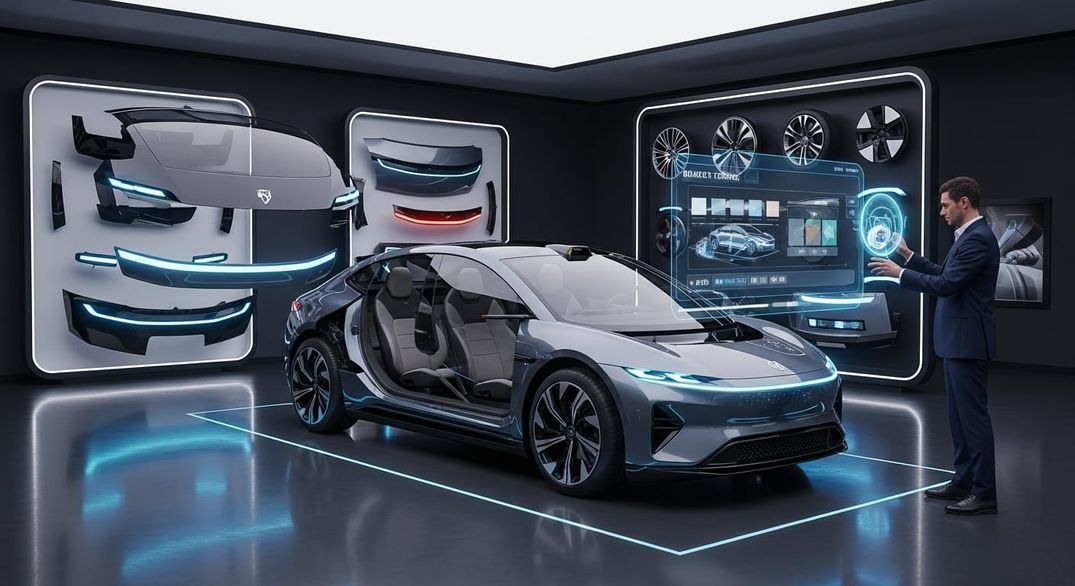
And there's a new entrant to the space taking the wholly disruptive approach with modularity: Slate Auto. Targeting the low-end of the market, they're offering the base skeleton and platform of a car at the mid-$20k range. Layered on top are the available personalization possibilities, from colors to wheels to doors and lighting, venturing into components that are typically only available as aftermarket upgrades or would otherwise be fixed designs. Hell, even the form factor is changeable: everything from sedan, to SUV, to pickup truck.
Amazingly, this barebones approach, if they're able to hit their price point goals, makes Slate the cheapest EV in the US, and also one of the most affordable cars overall. The fact that there's a startup trying to build a new car—well, a new set of cars—on the low-end speaks to how much electrification has simplified automotive architecture as well as driven down costs. As the Law of Conservation of Modularity predicts, when integration has driven quality to a mature plateau, the next step is modularization. It sure seems like we're now on the slope of enlightenment in the electric vehicle arc.