
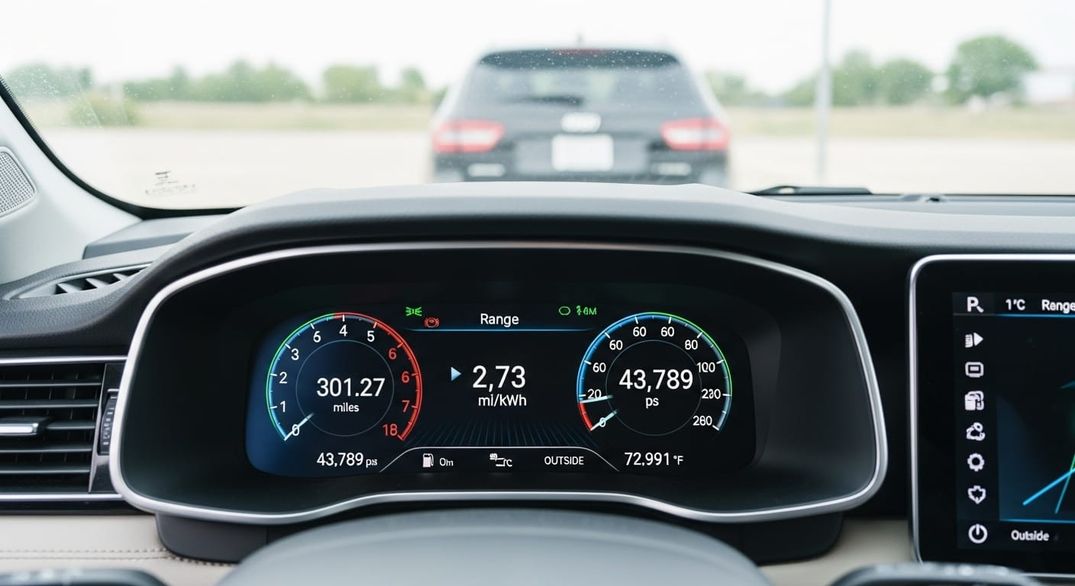
We have become very good at measuring things; it's unclear how that affects our ability to make decisions.
Take the Lucid Gravity. It's a new car, with a software interface evolved from their first vehicle—the Lucid Air—which they simply call UX 3.0. One of its new features is the "Dynamic Range," measuring the real-time efficiency of the drivetrain and battery and how it affects the car's range. As I'm driving along, listening to the horrible soundtrack that my kids have picked out for the road trip, the gauge is telling me that I'm doing 2.73 mi/kWh along this stretch of freeway[1].
Another example would be the Oura Ring, or really, most smartwatches and wearables. Mine syncs in the morning to let me know that on a good night, I slept a total of 6 hours and 50 minutes; on a bad one, 5 h 17 min with an efficiency rating of 92%. The smart scale tracks every instance that I step onto its glass plate, estimates body fat percentage to a tenth of a percent, and files the numbers away in Apple Health so it can build a line graph going back months and years.
Even my kids' grades arrive with precision. The letter grade may be a B+, but the numerical score boils down to an 88.93.
Now, much of this precision is due to the increased sensitivities of our equipment doing the measuring. Instead of eyeing the fuel gauge's position between the F and E markers on the dashboard, we run complicated algorithms to divine battery capacity from current and voltage measurements. Wearables detect heart rates and blood oxygen levels every couple of minutes to aggregate their workout and sleep data. Course grades are generally weighted sums of the semester's homework and tests, maybe with a bonus assignment thrown in.
But calculating to multiple decimal places creates unjustified confidence—a false precision. The techniques that EVs use to provide their estimated range and efficiencies aren't absolute; how far the vehicle can go on its battery charge depends on a lot of external factors like temperature and battery conditioning that are impossible to represent with a single number. Similarly, my sleep score and times are at best inferred from periodic, sometimes inaccurate measurements.
And all this additional precision doesn't necessarily make for better decision-making. In fact, most of the added decimal places and fractions of hours don't help in deciding what next actions to take upon receiving the data. Our minds don't work in terms of tenths of a percent; we reason with binary outcomes, thresholds and patterns and broad ranges. We want to see a car with over 300 miles of range, or want our kids to get at least A-'s on their best subjects in school.
To their credit, some of these measurements are framed with helpful UI and context, including labels that are human-understandable and human-actionable. This is done by rendering graphs and charts, to emphasize trends and ranges instead of exact values. This intentional abstraction avoids overfitting to noisy, potentially misleading data. What you lose in numerical sharpness, you gain in judgmental clarity.
For context, this is a pretty good number for a big SUV like the Gravity; smaller EVs like Tesla's Model 3 & Y get >3 mi/kWh while big boxy SUVs like the Rivian R1S routinely dip below 2 mi/kWh. ↩︎