
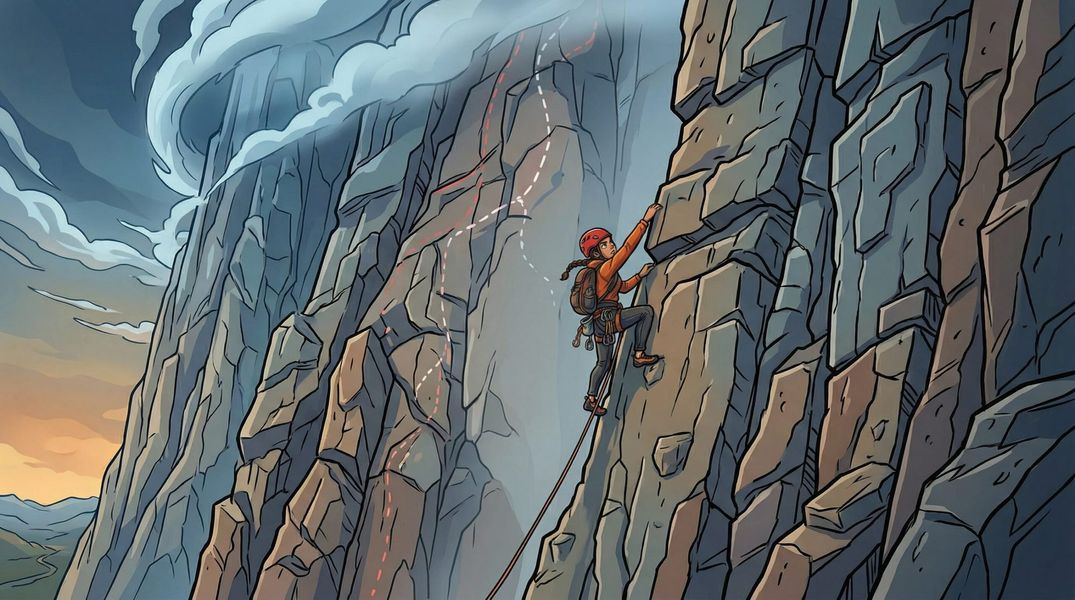
Cairn is a game about climbing. It was released merely days after Skyscraper Live , a Netflix special also about climbing. I'm not a climber; the closest I've gotten was fumbling on gym walls back in high school. Yet I am drawn to the psychology of climbing: the focus, the compression of goals into pieces of rock jutting from cliffs.
It's intense concentration, narrowing the world to a singular task—flow. Athletes sometimes describe it as time slowing down; knowledge workers can similarly enter into grooves and forgo meals while immersed in their projects. Cairn succeeds because its mechanics combine to capture that feeling.
Now, plenty of video games have climbing as a part of the gameplay. For most action games— Uncharted and Tomb Raider come to mind—climbing is straightforward traversal. The character's path is predetermined, so the player just has to move in the general direction and jump at designated spots to clamber through rough terrain. More technical games like Jusant and The Legend of Zelda: Breath of the Wild let players climb freely, but employ stamina systems to preserve level designs. In every case, though, the player jumps or moves in a direction, and the game automatically animates the grabs and holds that make the character's movement feel natural.
Cairn insists on manual movement. Whenever your character Aava reaches the base of a wall, she starts her climb by placing both hands and feet on the rock. Each limb is then adjusted by the player, one at a time, one position at a time. The procedural animations let us to perform moves in-game used in the real sport.
This design makes climbing slow and deliberate. When I first started the game, I noticed the immersive stamina system, with Aava visibly shaking her limbs to show fatigue. Informed by some of those other games with climbing systems, I assumed that Cairn was looking for a quick scramble up the slope before stamina runs out. This assumption and tactic stopped working by my third climb, as the cliffs got too high to brute-force routes. Instead, I found out, through trial and error, that the game rewarded committing to strong holds on the wall. In most cases, I succeeded by carefully waving a limb around, looking for deep crevices or textures to latch onto before moving the next limb.
What makes this mechanic work is the natural design of the cliffs. Cairn 's level designers made sure to include enough climbable surfaces to let players make progress[1], but their designs avoid video game tropes like splashes of paint or artificial ledges to hint to players where to proceed. If a cluster of rocks looks climbable, it's up to us to try to stretch a limb to reach a hold, and move each leg to pull herself up to the section above.
Naturally, it's easier to stay on solid ground, crane the camera up, and chart out a plausible route before starting a climb and consuming precious stamina. The game helpfully provides a zoomed-out view of the immediate surroundings, which makes it much easier to scout out potential routes and plan an ascent before committing. In the Cairn subreddit, players have been sharing their in-game route discoveries, much like how real-life rock climbers find and mark new climbing routes.
Thus emerges the actual gameplay loop: discovery, scouting, planning, execution.
Adding to this game design is Cairn 's story and environment. Story-wise, we watch Aava start her journey with well wishes from her partner and professional agent. But as she climbs, she distances herself both physically and emotionally from these close relationships to focus solely on the mountain. She treats most of the mountaineers along the way with cold indifference, remaining more comfortable in social isolation. In a perverse way, this narrowing of her attention contributes to maintaining her state of flow, but the game makes it clear, from beginning to end, the terrifying costs.
The mountain we climb is Kami; it's unclear whether the name is a reference to the Japanese term for deity (神). It is, by far, the most imposing element I've encountered in a video game. At the start of the game, once we get through the tutorial gym level, Aava climbs onto a ledge and the entire mountain is visible in the distance. Reminiscent of Breath of the Wild , we soon realize that the landscape is not simply a painted backdrop—with enough determination, we can scale the behemoth.
In practice, the game does break up Kami into discrete sections, or levels in video game parlance. Every time Aava scrambles up a ledge onto a broader flat surface, the level design allows for a break and a save point, but there always seems to be more rock in the background, more mountain only a short walk away. Naturally, we angle the camera up to restart the gameplay loop—discovery and scouting—and there's a mountain's worth of climbing already in front of us to get to the next ledge, a mile above.
Taken as a whole, Cairn weaves elements of adventure and escapism, into the challenge of an impossibly large task. The game is designed to be slow and deliberate, in one continuous climb, forcing us to progress in careful, methodical steps—all contributing to our sense of focus and flow. At its best, the game teaches us how to play better through this repetition and feedback, improving our skills organically[2].
So when Aava loses her grip and yells in frustration, well, we yell right along with her, as our flow state shatters. Then we shimmy up the rope and try again.